Listeners:
Top listeners:
-
 play_arrow
Strath Hits Radio
-
 play_arrow
From Europe to Africa: Strathmore Students Return with a Renewed Global Vision Paul Musingi

What Are You a Slave To?


It started at Mass.
Fr. Martin Mundia was preaching and I was doing what I usually do in the first few minutes of a homily. Half-listening, half-processing the week, mentally reorganising my to-do list while nodding at appropriately spiritual intervals. Then he said something that cut straight through.
He called us NATO. No Action, Talk Only.
He wasn’t being cruel. He was being precise. The reason it landed the way it did is because I knew, sitting there in that chapel, that he was right. Not just about Kenyans in the abstract. About me. About the version of me that leaves Mass with a full heart and an unchanged life.
I have been thinking about that word ever since. Let me tell you about a Tuesday two weeks ago.
I was walking through town. Mid-afternoon Nairobi, the sun sideways, streets full, everyone navigating everyone else. I needed to cross the road. There was a pedestrian crossing, clearly visible, maybe twenty meters to my right.

I crossed elsewhere. Not because the crossing was broken. Because it was slightly faster. Because my feet had already decided before my brain finished the sentence. Three seconds. Done. And I didn’t think about it again until that evening, when I started asking a question I had been avoiding.
What am I actually a slave to?
Not in a dramatic, chains-and-shackles sense. In the small sense. The three-second sense. The sense in which my habits tell the truth about my values more honestly than anything I would say if you asked me directly.
A few weeks before that, I was standing near a street vendor, a man selling smokies from a cart on a busy Nairobi pavement. When his hour was done and the crowd had thinned, he reached under his cart, took out a small brush and swept the area around him clean.
The wrappers, the used sticks, the debris of an afternoon’s trade. Methodically. Without a word. Without an audience. I stood there longer than made sense.
Because I realised I had just witnessed something I genuinely could not say about myself. I have never swept a pavement in my life. Not even once, keep it in mind that I attend one of the most academically rigorous universities in East Africa.
I have read about civic virtue. I have sat in lectures about leadership and the formation of character.
This man with a smokie cart just taught me something none of those rooms did.
Responsibility does not wait for an audience. It is what you do with the space you have occupied, when the crowd is gone, because you have decided that is simply who you are.

Now here is where it gets uncomfortable for me specifically, because I go to Strathmore.
We have standards here. We have an ethos, a stated one, one that is embedded in the institution’s founding and its Opus Dei tradition and the way it talks about forming the whole person, not just the professional. And I think that ethos is real. I think something genuine is being attempted here and I do not say that as flattery.
But I also think that when I look at our immediate environs, the streets adjacent to this campus, the common spaces, the small daily behaviours of people who pass through these gates, I have to be honest about what I see. And what I see tells a more complicated story than our prospectus suggests.
Which means one of two things. Either the ethos has not reached us yet or we are complicit in the gap between what this institution says it stands for and what we actually do when no one from the institution is watching.
I think it is the second one. I think I am the second one. I want to be honest enough to place myself first on that list, because I am the only person on this list I have direct authority over.
I am comfortable. I am too comfortable. I have convinced myself that attending the right institution, reading the right books, sitting in the right lectures, is itself a form of action. It is not. It is preparation for action, preparation that never converts is just another sophisticated form of ‘NATO’.
Dostoevsky puts it through Father Zosima in The Brothers Karamazov: “Above all, don’t lie to yourself. The man who lies to himself and listens to his own lie comes to a point where he cannot distinguish the truth within him, or around him.“
I know that man. I have been that man. Probably this week. The matatu conductor said it best.
I was on a matatu, already full, when someone boarded and we all shifted to accommodate. The conductor looked around at us and said, with a grin that contained the entire tragedy:
“Ni sisi tu Wakenya ndio huinsist kujaza gari juu niko na haraka.”
It is us. Just us Kenyans, insisting on filling the vehicle past capacity because I am in a hurry.
Everyone laughed, including me, including the person whose boarding had made the laughter necessary. We laughed and then continued to sit inside the truth we had just laughed at without shifting an inch.

President Ruto speaks about the Road to Singapore. Lee Kuan Yew built a functioning nation from a swampy city with no resources and a fractured population. What he built was a culture of accountability so pervasive it stopped needing enforcement because it had become internal. The infrastructure followed the culture. The culture came first.
But culture does not come from nowhere. It comes from individuals who decide, one at a time, that the standard begins with them.
Solzhenitsyn said it in his Nobel lecture: “One word of truth shall outweigh the whole world.” Not an army. Not a movement. One person, with the courage to refuse the comfortable lie.
We have seen it. Gandhi, Mandela and above all, Christ, who is for me the absolute fullness of that idea, one life lived in complete integrity with its stated truth and the world has not recovered from the disruption of it.
I am not Gandhi neither am i Mandela. I am a BBIT student at Strathmore with a complicated relationship with pedestrian crossings.
But that is exactly the point. The disruption always starts smaller than history makes it look. It starts with one person who decides that the gap between what they believe and how they live is no longer acceptable. Not because anyone is watching. Not because the system rewards it. Because they have decided that they are the standard and the standard starts now.

So what can I actually do?
One of my intellectual heroes Jordan Peterson writes in 12 Rules For Life that you should “compare yourself to who you were yesterday, not to who someone else is today.”
The national narrative of failure is a comfortable shadow to hide in. If Kenya is broken, my small brokenness dissolves into the aggregate and I am absolved without cost. But it does not dissolve. It composes the thing I am complaining about.
Here is what I am trying, imperfectly, starting this week.
Take the pedestrian crossing. Not because one crossing changes Nairobi. Because who you are when no one is watching is who you actually are and that person compounds.
Clean the space I occupied. The desk. The cafeteria table. Leave it the way the smokie vendor left his pavement.
Finish what I start before I announce what I intend. Because announcement without execution is the most refined form of self-deception available to educated people, and we are gifted at it.
Say something when something wrong is said confidently by someone with authority. Quietly if possible. Clearly, always.
None of this is Singapore. None of it is policy. But I believe it is the floor on which everything else has to be built.
Saint Augustine ends the first book of the Confessions not with an answer but with a re-orientation. He does not claim to have arrived. He claims to have found the direction. That is where I am.
Don’t throw the baby with the bathwater. Kenya is not a cursed place. This institution is not a failed one. But the gap between the ethos on the wall and the life actually being lived, that gap is filled by individual choices, mine first, before anyone else’s.
What am I a slave to?
Not what is the government a slave to. Not what is the culture a slave to.
What am I a slave to? Start there. Start with the twenty meters. Start with the broom.
Article By Denzel Mark Damba

Featured post
Latest posts

From Hope to Impact: Evaluating Social Programs for Evidence-Based Policy in Africa Every policy comes bearing hope
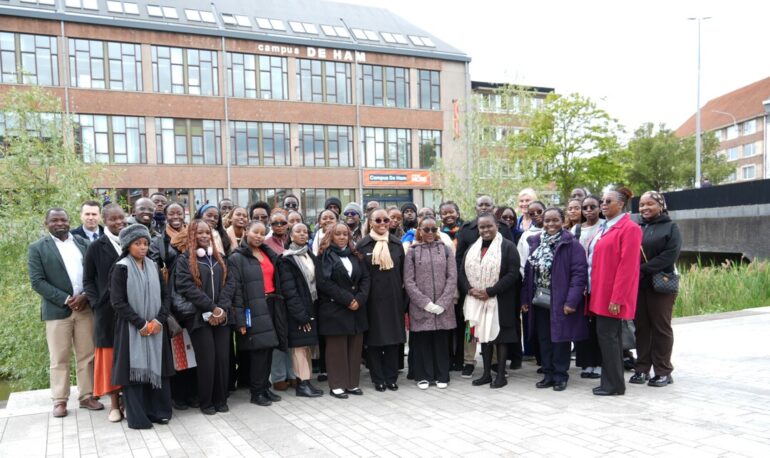
From Europe to Africa: Strathmore Students Return with a Renewed Global Vision

What Are You a Slave To?

From Nairobi to Vienna: A Life-Changing Exchange Experience

How Coca-Cola Is Rewriting Youth Engagement: Inside the “It’s That Fresh” Campaign
Current show
Upcoming shows